Syllabus
preamble
~ notes on wandering
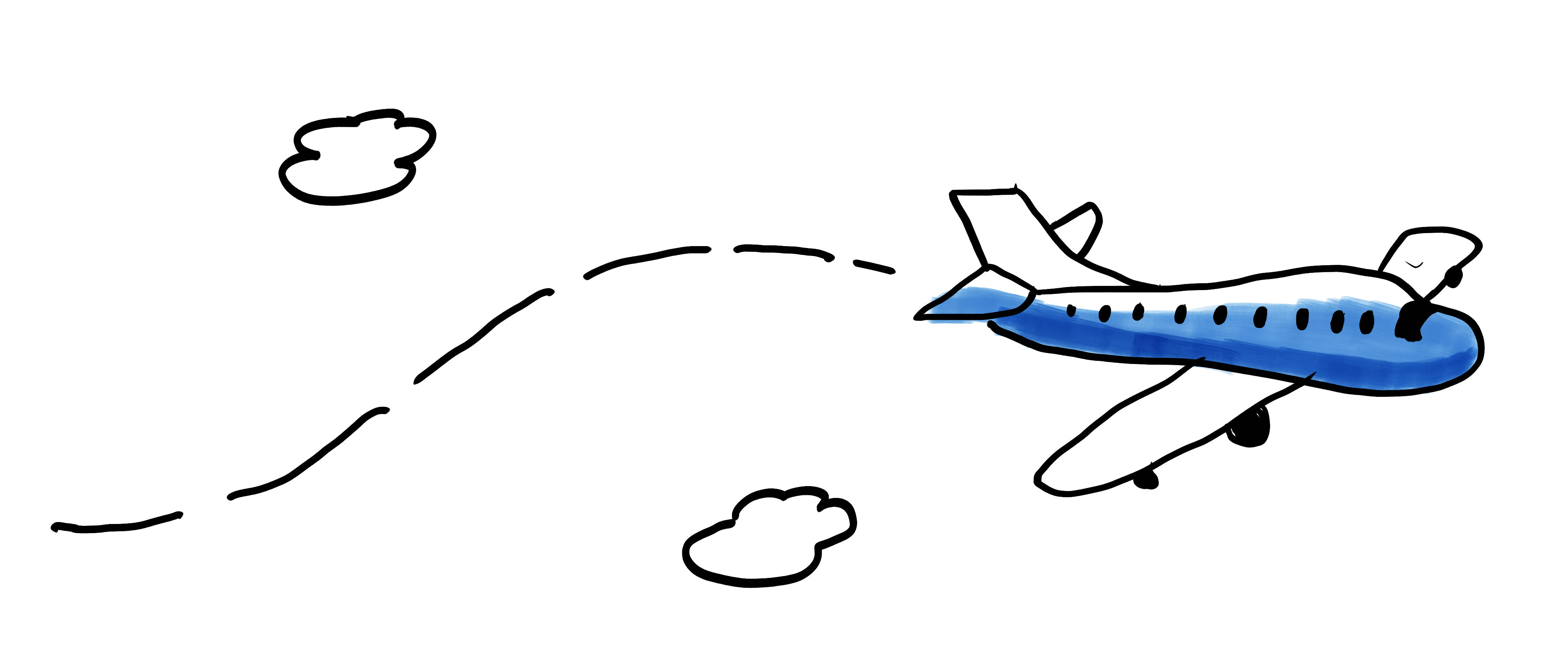
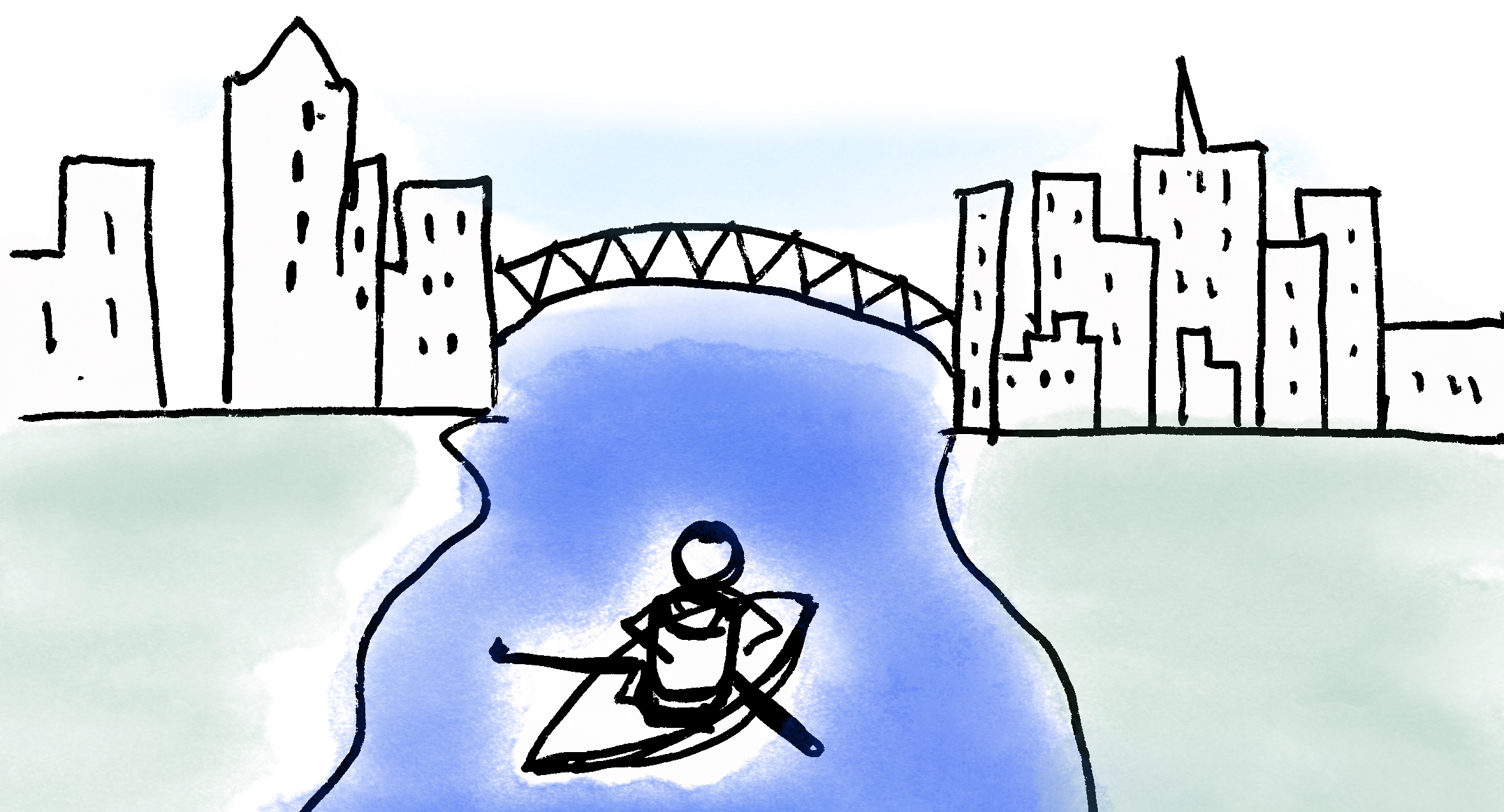
When I travel to a new city, I like to plan only three things: how to get there, how to get back, and where I’ll be staying. When I arrive, I’ll pick some direction (or maybe, if i’m feeling extra prepared, some famous landmark) and wander towards it in some detour-filled, inefficient manner.
Wandering through cities is what makes them feel most real and alive to me. For just a moment, I’m joining its residents in the best parts of their daily lives: discovering a hole-in-the-wall bookstore; running up ancient stairways for morning exercise; biking along a river at sunset on our commute back home.
I’m realizing that ‘wandering’ is a pattern of learning and discovery that generalizes further than just traveling to physical places. ‘cities’ can be a stand-in for ‘communities’ or ‘hobbies’ or ‘scientific fields’ or ‘planes ↗’. The real fun isn’t in getting to somewhere or arriving where I want to; it really is in the unplanned, tangled, messy path I forge as I go.
By writing this document, I’m booking my next round of flights into mindspace. I’m committing to exploring a handful of topics that I believe are high-impact, well-fitting to my personal interests, and fun to think about. And although I’ve seen glimpses of them from 30,000 feet, I now look forward to wandering through their side streets and many intricacies in search of unknown unknowns.
About this document
This document was the product of nearly two years of thinking and journaling and dozens of scrapped drafts, originating from some foggy morning on BART somewhere between Colma and Daly City in February 2024.
This research syllabus is my first successful attempt at formalizing and sharing my personal values in a way that makes sense to me. “Research” is not at all an important aspect of why I wrote this document; it’s just the form I’ve decided to wrap my identity and values into at this exact moment in time.
More directly, my goals for this document are as follows:
- To explore research as a primary identity: how do I define and practice research; why do I feel compelled to apply it as a label for myself?
- To identify my main interests: what is the short list of topics I spend most or all of my time thinking about / enjoy thinking about the most?
- To communicate my personal and career aspirations for the immediate future: what am I hoping to understand and achieve in the next year or two, and who do I need to find to make that a reality?
00. foundations
SCIENCE RULES!!! - Bill Nye
After years of trying and failing to develop a sticky answer to “what do you do?”, I’ve accepted that my personal identity is ephemeral. At some point in my life, I’ve assumed the roles of student, teacher, musician, writer, engineer, event planner, game designer, artist, and more— often several at once.
In the next phase of my life, I expect my dominant identity to be that of a researcher. “Research” is an especially broad term that could mean a lot of things, so the first task of mine will be to define what research means to me and begin developing effective frameworks to conduct and iterate upon my research practice.
Why research? (an anti-syllabus)
For the last couple years of my life, my primary identity has been that of an engineer.
So far, I’ve really been enjoying living in engineer-world as a default, and happen to be decently good at it! But ever since I started working, I’ve had a nagging feeling that this wasn’t exactly what I was looking for. My identity as “engineer” always felt like a temporary label; an in-between transitional state that could take me towards something else.
Not soon after starting work as an engineer, I started exploring what this “something else” might look like. I stumbled upon the world of Substack and experimented with an identity as a writer. For as long as I could I’d stay up late nights every Tuesday to crank out a newsletter entry; I’d obsess over how to get subscribers; I’d go to Writing Club and talk with other upcoming writers and bloggers and swap newsletters. My website was headlined: “I make things and write about them sometimes.” But this, too, felt like an unsustainable practice; it lived in a completely different universe from my engineering work and often conflicted with it.
There happens to be a great deal of overlap between writing, engineering, and research. Naïvely, if I had to break down research into smaller components, it might look something like roughly equal parts of:
- reading (understanding the state of the art)
- writing (contributing to the state of the art)
- thinking (originating new ideas)
- experimenting (gathering evidence for your findings, and building the systems to interpret them effectively)
- collaborating (exchanging findings with people who care)
- teaching (distilling the field’s fundamentals so students / future contributors can understand your work)
These just so happen to be six of my favorite things— and this re-framing feels like a satisfying evolution from the writer/engineer split I’ve tried to live in for the past couple years. My work, both inside and outside the office, can finally share a common home.
What does it mean to “do research”?
So far, I’ve conceptualized research as identity.
Here are a few other frames I believe are worth exploring in conjunction. I’m not yet sure how to unify them (and they currently conflict with one another in various ways), but they’re all compelling enough to include as value-building context.
Research as leisure activity
Celine Nguyen’s namesake essay ↗ is quickly becoming one of my favorite pieces of writing, and is a big piece of what inspired me to make the transition towards research.
Her main point is as follows, in a few select quotes (though you should read the whole thing— it’s well worth your time):
The phrase “research as leisure activity” suggests, for me, a form of research that is explicitly not isolated to traditional institutions. Research as a leisure activity includes the qualities I described above ↗: a desire to ask and answer questions, a commitment to evidence, an understanding of what already exists, an output, a certain degree of contemporary relevance, and a community. But it also involves the following qualities:
- Research as leisure activity is directed by passions and instincts.
- As a result, research as leisure activity is exuberantly undisciplined or antidisciplinary.
- Research as leisure activity involves as much rigor as necessary.
There’s something deeply compelling to me about the idea that research—in some form—can be done by anyone with a serious commitment to intellectual inquiry.
While I think there is still tremendous value in conducting research in structured institutions (like an academic or industry lab), it’s a wonderful reframing to suggest that research can also be done by anyone, anywhere, in a playful yet rigorous manner.
Research as bridge-building
In one of my earliest essays ↗, I explored the paradigm of tall versus wide:
If my own knowledge had a physical form, I’d imagine it to look something like a sphere.
Meanwhile, an expert’s knowledge would appear more spindly, growing up and up towards the ceiling until it finally broke through and expanded what we knew as a species.
Even though building tall has a much clearer technological benefit, I still think going wide is just as important. A whole bunch of isolated ideas aren’t useful without those of us willing to build the bridges across them as well. In a world flooded with information, I hope to make it that much easier to discover what you’re looking for.
- The Sphere of Knowledge ↗, published May 15, 2024
Overall, this essay dates itself rather tremendously— but in a good way! I’ve grown so much since then that many of the assumptions I’d made about myself and the world in it are no longer valid.
But the one key idea that still holds true is my desire to build bridges as a default. I think the most interesting areas of research live in the murky in-betweens of established fields. If anything, the act of bridge-building is a valid field in itself— by studying the frameworks that accelerate research, I can more effectively choose and develop my areas of focus.
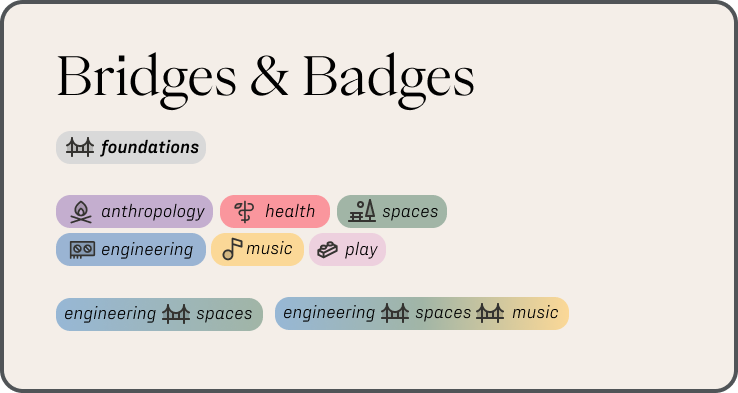
Throughout this document, and in future documents I produce, I intend to badge contents with the intersection of categories they touch upon.
Research as a design problem
If I had to summarize my research interests in a few words, I’d reckon it would be human-centered systems design. The fun part about this focus is that researching how to do better research is, in itself, a human-centered systems design problem!
Perhaps the most well-known researcher of generalized systems design is Christopher Alexander ↗. While Alexander was an architect by profession, his most famous theories extend far beyond their original domains. (One notable example is the concept of a pattern language ↗ - which has since become a foundational idea of computer science.)
My overarching hypothesis on this topic is that as I live through more experiences and meet more people, smaller  frameworks ↗ will slowly merge into larger ones. Eventually, I predict I’ll hold a very small number of key frameworks that are highly generalizable and accurately describe my personal values on their own.
As of today, I’ve assembled a small collection of frameworks about individual topics, like how to organize fun events with friends ↗ or how the Open Computing Facility operates ↗. Part of my research practice will be to identify the commonalities between these. (For example, I expect that both of the above will soon act as smaller parts of a larger ‘community spaces’ framework.)
Research as personal agency
The concept of ‘personal agency’ has been around for quite some time, probably having originated from Aristotle’s philosophy on action ↗.
In very general terms, an agent is a being with the capacity to act, and ‘agency’ denotes the exercise or manifestation of this capacity.
—From the Stanford Encyclopedia of Philosophy ↗
In a more modern sense, I’ve noticed an increase in the usage of ‘agency’ over the last few years to describe one’s ability to narrow the delta between where they currently are and the future self they strive to become (and the future world they want to live in).
Although my current understanding of agency is rather limited, I’ve enjoyed reading some of Cate Hall ↗’s recent essays as a starting point in my exploration. Her primary definition of agency revolves around this idea:
agency is about finding real edges: things you are willing to do that others aren’t, often because they’re annoying or unpleasant.
Borrowing her definition, my research practice could be framed as an exercise of personal agency— I’m identifying the areas of impact I gravitate towards, and figuring out how I’d be able to contribute meaningfully to them in a way I’d find enjoyable but most others would find unpleasant.
(The most obvious example so far: I find planning and hosting events to be quite fun and low-effort. Most people I’ve met consider it a difficult and tedious affair, and struggle to relate— a sign of a niche I’m able to fill!)
Agency is the skill that built the world around you, an all-purpose life intensifier that lets you make your corner of it more like what you want it to be, whether that’s professional, relational, aesthetic, whatever. Build a better mousetrap. Have an enviable marriage. Start a country. No one is born with it, everyone can learn it, and it’s never too late.
—Cate Hall, “How to be more agentic” ↗
Research as a post-LLM cultural shift
Now that large language models (LLM’s) have almost
Several aspects of research that could aid in this culture shift include:
- Quality over quantity: Writing a super long essay no longer holds the proof-of-work validity it once implied. (If anything, the burden’s now on long-form writers to prove that they didn’t AI-generate it!) I find myself valuing human curation of sparse ideas into dense, highly meaningful artifacts that point me in the right direction while helping me understand why I care and how I should feel about it. Reading the work of great researchers is one of my primary feeds for highly-curated knowledge.
- Intention over implementation: Although there will always be a craft around understanding the minutest intricacies of a trade, it’s becoming clear that allowing AI to replace the most mundane tasks (like taking meeting notes or writing unit tests for code) frees us up to take on higher-leverage tasks (like research). For example, I can spend much more time thinking about what I’m writing here instead of fiddling with CSS to make this website pretty to look at!
- Taste as currency: Taste, to me, is the process of identifying what creates joy for myself and understanding how to externally present that joy to others. I hope that my research will eventually become a legible form of good taste that highlights the things I love doing while providing a source of inspiration.
Users’ Guide
As I’ve noted occasionally before, one of the most potentially useful things that academics do is preparing syllabi, and hence organizing information about the world.
Past this point, the syllabus becomes notably sparser. The purpose of each section is merely to provide a starting point for future exploration— there’s a lot I don’t know! I expect topics to expand and collapse, shift direction, or be fully reconstructed at some point in the near future.
If you have any relevant personal experiences / are an expert in the field / have qualms with my prioritization or framing of problems, please reach out! I’m extremely open to making major changes given compelling enough feedback.
Sections are roughly organized in order of importance (within my understanding of the world at the present time).
Big Questions
Each section will begin with a list of high level research questions I’d like to answer and don’t yet have a compelling answer to. For example, here are a few meta-questions I have about research design at the moment:
- What does effective research look like in a post-AI era?
- What is my definition of research? What are the primary components of research (i.e. what would a typical day as a ‘researcher’ look like)?
- How do I conceptualize research as systems design? What is the role of existing systems and institutions in enabling research?
Reading Lists
Each section contains a reading list containing the books, articles, blog posts, podcasts, and other long-form media I intend to use as a starting point for my explorations. Although I hope to get through all of them, they’re also the most volatile sections of this document and are subject to addition (or removal) at any time.
Here is the reading list for this section. It contains some foundational pieces on which I’ve built parts of my research practice on top of.
Introduction to General Systems Design
- Christopher Alexander: A Primer ↗ (found from this Henrik Karlsson essay about unfolding ↗)
- Notes on the Synthesis of Form - Christopher Alexander
Popular Literature
- Gödel, Escher, Bach: an Eternal Golden Braid - Douglas Hofstadter
Internet Research
- Research as a leisure activity ↗ - Celine Nguyen
- The independent researcher ↗ - Nadia Asparouhova
- Staring into the abyss as a core life skill ↗ - Ben Kuhn
Personal Agency
- On agency ↗ - Henrik & Johanna Karlsson
- How to be more agentic ↗ - Cate Hall (and, her to-be-released book You Can Just Do Things)
‘How to do research’ guides from my mentors and their mentors
- https://people.csail.mit.edu/fredo/DoGoodResearch.pdf ↗
- https://people.csail.mit.edu/billf/www/papers/doresearch.pdf ↗
- https://www.cs.virginia.edu/~robins/YouAndYourResearch.html ↗
- http://joschu.net/blog/opinionated-guide-ml-research.html ↗
- https://michaelnielsen.org/blog/principles-of-effective-research/ ↗
01. spaces and community
There’s this myth that if you become your biggest, best, most beautiful self, you’re going to take up all the space and there won’t be any room for anyone else. And it’s actually the opposite. When you are comfortable in your own skin, you create so much space for everyone else to also be their best selves.
And so when you speak, when you sing, when you play, try and bring every single part of yourself—all the parts that you find weird, or dark, or strange, or unacceptable. — Jacob Collier ↗
If I ask: What do I need to be the happiest, healthiest, most fulfilled version of myself? — The answers that come to mind are surprisingly simple, but yet seemingly quite difficult to find in most places in the Bay Area (and wider America):
- I’d like to be able to walk and bike to places as a default.
- I’d like to live close by to friends and family (and maybe befriend my neighbors, too).
- I’d like to eat (and cook) great food and share meals with others.
- I’d like to afford the time to take care of myself physically and mentally when I need it.
- I’d like a safe, clean, and comfortable space to live in that feels like home to myself and anyone who comes by to visit.
- I’d like to live amongst a community of people who are also happy, healthy, and fulfilled— who build great local businesses, share their talents, and support one another through challenges.
A common theme that I notice amongst these basic needs is that they primarily stem from a desire to foster communities around my physical environment. Secondarily, I’m convinced of the fact that the most effective way to build community is to create spaces in which they can thrive.
The concept of “space” takes a lot of different forms: although physical spaces are the clearest example, I also think there’s a lot of credence to studying less tangible constructs like digital spaces, institutions, and social networks. While I’m generally critical of mainstream social media, I’ve enjoyed exploring alternate modes of existence online and hope to explore patterns like digital gardens, local-first computing, and the poetic web ↗ to help make the internet feel more alive.
Recently, I’ve been hosting lots of events and otherwise inviting my immediate circle to spend time together. I believe the next step will be to expand this circle from disjoint collections of friendship into some more tangible, concrete sense of community- both physically and digitally.
- What are the paths towards improving the built environment around me? The Bay Area is a notoriously car-centric, spread-out, expensive place to live where socioeconomic tensions run high and the definition of a ‘fun Friday evening with friends’ for many is pulling up to a local Target. What policies, infrastructure improvements, or other systems do we need to change to rebuild our urban fabric with people and communities in mind?
- What is the relationship between physical and digital space? How can we use the Internet and social media in a way that has a positive impact on our IRL communities, and vice versa?
- How can we develop lower-effort, repeatable frameworks for community building? What systems can we develop to empower everyone to seek and build the communities they’re looking for?
Pop Literature
- The Art of Gathering - Priya Parker
Community Building
- The Community Canvas ↗
- The Socratica Toolbox ↗ and related articles (World-building IRL ↗)
The Future of the Bay Area
- Plan Bay Area 2050+ ↗ : The latest revision of the Bay Area’s long-term planning vision as of October 19, 2025.
- San Francisco General Plan ↗: The future of SF.
- Various other general and specific plans from around the Bay Area.
Urban Planning Theory
- A Pattern Language: Towns, Buildings, Construction - Christopher Alexander
- Order Without Design: How Markets Shape Cities - Alain Bertaud
Digital Spaces
- The Post-Individual ↗ - Yancey Strickler
- The Resonant Computing Manifesto ↗
- A Brief History & Ethos of the Digital Garden ↗ and related articles (Of Digital Streams, Campfires and Gardens ↗, My blog is a digital garden, not a blog ↗, My website is a shifting house next to a river of knowledge. What could yours be? ↗)
- Handbook of Social Computing (2024)
- The Cultural Anthropology of Stack Exchange ↗ - Joel Spolsky
02. systems for machine learning
For many of my friends and colleagues, the ongoing Apple TV thriller Severance feels like a déjà vu episode of Silicon Valley from ten years ago: “I could only get through a couple episodes”, they’d say; “it hit way too close to home.”
Severance is primarily about a group of workers who have two separate identities: their in-office selves have no conception of the outside world, and their out-of-office selves have no knowledge of how they spend their time at work. Among many other themes, it critiques the disconnect many people feel between their work and non-work personas.
The presence of this section in my research syllabus is as much about identifying the importance of ML systems as it is about definitively closing that personal rift. For the first time in my career I’ve found a way to celebrate my full-time work as a core part of my personal identity rather than living with the cognitive dissonance of assuming entirely separate, conflicting value systems inside and outside the office.
With that preface out of the way, there are quite a few problems I feel both excited and uniquely positioned to tackle in the coming year in my work as a systems engineer. I imagine the reasons for AI/ML research being useful and high-impact are well-understood at this point; personally, I just feel extremely lucky and grateful to have the opportunity to work so closely to the undisputed defining field of the decade.
- How can we manage and scale heterogeneous compute resources for distributed model training? Although the largest labs get much of the media coverage for their hundred-billion dollar GPU deals and massive datacenter buildouts, everyone else doing AI research (including in academic settings) is generally scrambling to get their hands on any and every compute resource they can scrape together. These resources are often on different architectures, in datacenters managed by different companies, and spread out around the world— and are therefore quite difficult to leverage, especially for small teams.
- While I expect much of the solution to simply involve clever applications of well-understood systems patterns (particularly around observability), I anticipate there’s quite a bit of room for original thinking here.
- Heterogeneous compute may also serve as a key technology for democratizing machine learning research. By enabling faster, easier to use, more flexible hardware access, we ensure that compute power doesn’t get monopolized by a small number of very powerful companies.
- How can we build fault-tolerant training pipelines that minimize human-time and compute-time wastage from hardware failure? GPUs are currently far more expensive and far more unreliable than CPUs, and yet many training jobs are all-or-nothing (in that if one GPU fails out of thousands, the entire job could fail). What knowledge can we apply from the last 50 years of distributed systems engineering to solve this class of emergent reliability problems?
- What is the minimal set of knowledge needed to bridge the gap from matrix multiplication to model training? More specifically, the next major iteration of TurtleNet seems to me like a graduation from talking about homelabs to designing infrastructure for million-dollar GPU clusters. I’d like to fill in my own knowledge gaps so I can be more effective in my work— but it’d also be awesome to package up that knowledge in a digestible way for others to follow along.
- Stanford’s CS329S curriculum ↗ and/or the textbook ↗ that was born from its notes, as a survey for ML systems
- Attention is All You Need ↗ and related foundational works, to build the language necessary to talk about modern transformer models
- Demystifying NCCL ↗ and related works
- Ray: A Distributed Framework for Emerging AI Applications ↗ and related systems papers proposing generalizable solutions to ML systems problems
- More to come…
03. silicon valley anthropology
when you’re an introvert at a party… pretend you’re an anthropologist!
my hometown is one of the weirdest places in human civilization right now
Like many others, I went through an angsty phase of “the Bay Area sucks and I want to leave this suburban stroad-ridden hellscape and ride bicycles among the Dutch in the promised land of universal healthcare”. And so ride bicycles among the Dutch I did, and within a few months realized
- The Bay Area has so much to offer that the rest of the world doesn’t (and I very quickly missed these aspects),
- There is a lot of obvious room for improvement;
- I’m uniquely positioned to become a small part of that improvement;
- I’d be much happier spending the rest of my life trying to make my hometown a nicer place to live rather than running away from it.
Now that I’m very deliberate in my desire to stay around for a while, I’ve been seeking out ways to understand my community at a deeper level. As a first stop: by far the most dominant and omnipresent community within the Bay Area at the moment— the tech world, colloquially known as Silicon Valley.
For the last couple years, I’ve gained meaningful firsthand experience working within the depths of the Silicon Valley machinery. I frequently compare notes with my friends and colleagues dispersed among all the notable microclimates (Big Tech, top AI firms, Y-Combinator startups, venture capital funds…) and feel like I’m starting to understand the folklore behind it all.
My next step is to formalize my Silicon Valley folk knowledge in an actionable, professional, and publicly coherent manner. I don’t currently feel like I have a great grasp of what directions I want to go in towards contributing to the wider Bay Area community yet— hopefully, through this exploration, I’ll acquire the foundational knowledge I need to know where to head next.
- What are the core political and economic power structures that control Silicon Valley? How and why does venture capital work? What are the prominent value/belief systems Silicon Valley elites practice or evangelize, and how do those influences disseminate?
- How does the current AI hype bubble contextualize within the broader history of the Bay Area? How is the current landscape similar/different to the Gold Rush and dot-com eras? What might be the downstream effects of AI on the wider Bay Area community in the coming years?
- How does the tech landscape interact with or affect other prominent communities in the Bay Area? Some examples that come to mind: the Asian American diaspora (especially the older generation of Cantonese and Taishanese immigrants who settled in SF/Daly City/Chinatown in the 50s and 60s); the more established, historically significant culture centers of the East Bay (especially Oakland and Berkeley); the emerging art scene in San Jose.
Foundations of Anthropology
- Small Places, Large Issues: An Introduction to Social and Cultural Anthropology ↗ - Thomas Hylland Eriksen
- Writing Ethnographic Fieldnotes ↗ (Emerson, Fretz, Shaw 2011)
- A Brief Introduction to Digital Anthropology ↗ - Maggie Appleton (and, some selections from her reading list ↗)
Silicon Valley Culture
- Season of the Witch: Enchantment, Terror, and Deliverance in the City of Love ↗: historical accounts from San Francisco’s cultural revolution of the 60’s and 70’s; pride, drugs, hippies, rock & roll, political assassinations, and much more.
- Paul Graham’s Essays ↗: the definitive thinkpieces that have an outsized impact on Silicon Valley discourse.
- Jasmine Sun’s Substack ↗: live reporting on SF tech culture, China, and much more; a self-described anthropology of disruption ↗.
- Everyone here is in a cult ↗ - Cate Hall
Venture Capital
- kwokchain ↗ by Kevin Kwok
Rationalism
- Highlights from the Sequences ↗ - Eliezer Yudkowsky
- Reframing Impact ↗ - Alex Turner
- What altruism means to me ↗ - Neel Nanda
AI Zoomerism
04. health and wellness
So much of my mood (and therefore, my ability to focus on anything else) seems to be disproportionately determined by just three things: sleeping, eating, and exercise. If I’m not feeling great, it’s very likely that I’d neglected one or more of those three things.
I’d like to understand the mechanisms behind how sleep, diet, and exercise affect me, and how I can become a happier and healthier person through maintaining them.
I also believe that physical fitness can be a key component to community. Many of my favorite ways to spend time with others involve being active together (like playing sports, or hiking around a national park, or yapping at the climbing gym).
- What does it take to live past 100? What does current medical knowledge suggest about what habits increase lifespan/healthspan?
- What does a healthy risk-taking equation look like? How can I accelerate my personal growth and stretch my boundaries while ensuring I don’t find myself in dangerous (or even deadly) situations?
- What are the consequences of longevity becoming a cultural phenomenon? Why are so many people talking about (and working on) extending lifespan, especially in tech/Silicon Valley circles? What are the positive or negative downstream effects of longevity entering popular culture programming?
- What I Talk About When I Talk About Running ↗: Haruki Murakami’s memoir on his borderline-addiction to running, and how it relates to his life as a novelist.
- Outlive: The Science and Art of Longevity ↗: The current pop-culture zeitgeist of longevity science.
05. play (and music)
I’ve felt a prevailing sense that many young tech-oriented folks around me share a value system built around some statement like this:
Life is an N-dimensional vector space I need to derive an optimization function for so I can approach the Global Maximum and reach enlightenment by the age of 37.
I constantly need to remind myself to STOP OPTIMIZING!! There’s so much joy in the small, unexplainable moments: spending time with family on a lazy Sunday afternoon; taking a detour to watch the sunset during a road trip; rooting for your favorite team to win the Marble Olympics or whatever your sport of choice is ↗. Many compelling experiences aren’t research-shaped, but I still want to seek them out.
My hope is that while research becomes a comfortable default mode, I’ll still find ample time to do silly things (or nothing at all) with the people I like.
One specific example of a not-research-shaped source of immense meaning and joy in my life has been music. I’ve been playing piano for as long as I can remember, and have dabbled in music production on and off since middle school. Recently, I’ve been hosting weekly jam sessions with friends (where I’m learning how to play jazz bass)!
While I’m sure I can conjure up some reasonable explanation for why music means so much to me (it’s a shared language, making things is fun, it’s a creative outlet, etc. etc.), the truth is that I really don’t know, nor do I really care. I’m pretty sure I will continue making music for the rest of my life, and I’m more than happy to take time away from everything else if I feel that urge.
This list is a lot looser, and also contains non-text-related things.
Reading: the books on the shelf I tell myself I’ll read before I buy more, but end up buying more anyways.
- Exhalation by Ted Chiang - having greatly enjoyed his first collection of stories (Story of your Life and Others), I’m excited for more.
- How A Game Lives by Jacob Geller (and, revisiting all of his video essays in general).
- Crime and Punishment by Fyodor Dostoevsky
- Tomorrow, Tomorrow, and Tomorrow by Gabrielle Zevin
- Babel by R.F. Kuang
- How to Hide an Empire: A History of the Greater United States by Daniel Immerwahr
- The Long Walk by Stephen King
Video Games that will bring me tremendous joy, and are therefore worth retreating from the world for ~100 hours this year to play.
- Super Mario Galaxy + Super Mario Galaxy 2
- Hollow Knight: Silksong
- Hades 2
Music: repertoire to be published soon.
Other
- Works from The Pudding ↗ & exploring data-driven storytelling in general
the end
and here’s to the beginning of something new.
Colophon
All words on this page were written and edited by myself, without assistance from LLMs. Many others have contributed to its ideas indirectly through hundreds of conversations— I’d like to extend a note of gratitude to everyone who may have done so, even if we were both unaware of it at the time!
I designed this page in Figma (design file here ↗). Typography, iconography, and color palettes are based on the bencuan.me v7 design system. Doodles were hand-drawn by myself in Procreate ↗.
Stay in touch!!
If some or all of this document resonated with you, I’d love to know! Drop me a message and I’d be happy to find some time to meet up and hear about the ideas you’re pondering.
I have a lot of related writing that I’ll release on this blog (and elsewhere on the internet) in the coming months. The best way to get notified of these is to subscribe to my newsletter on Substack ↗. (The box below should do the trick too!)
For sketchier notes and random fun things, check out the Garden ↗— you can leave a message in the guestbook there too, if you’d like.